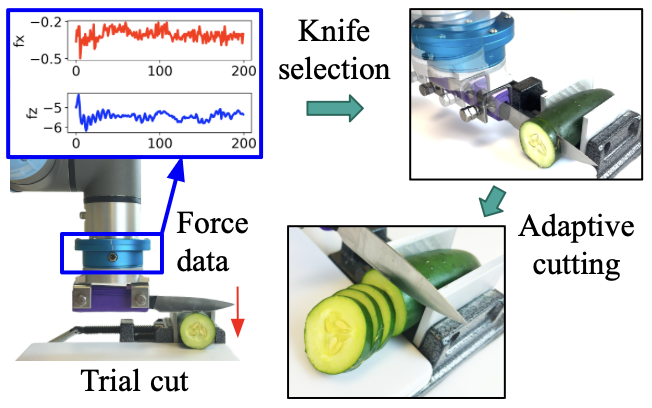
Food cutting is a fundamental skill for cooking robots, but different foods require different strategies and sometimes different tools. This work presents a perception-manipulation framework for robotic food cutting. The system first performs trial cuts with predefined motions to infer food properties from force data and select between a fruit knife and a serrated knife. It then uses an adaptive reinforcement learning controller to tune the target downward force and sawing speed during cutting, balancing speed and energy efficiency. In experiments, the knife selection module achieved a 100% success rate on unseen foods, and the adaptive controller produced performance comparable to human operators while outperforming fixed policies in reward.
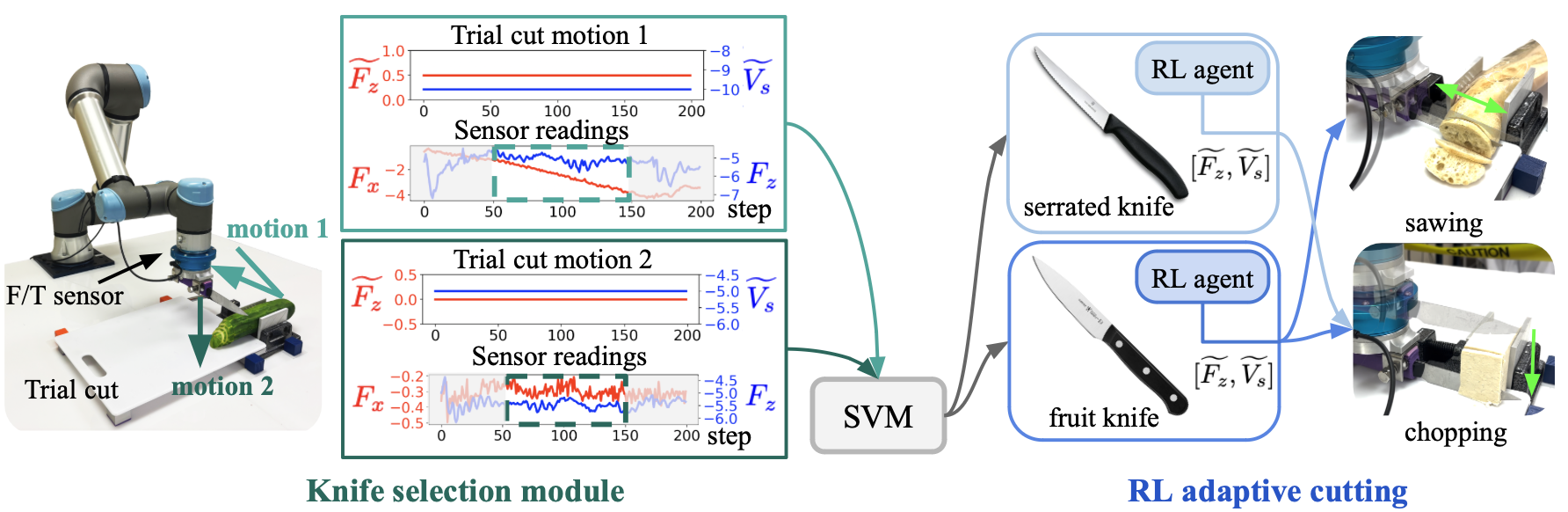
The robot begins with trial cuts that collect force readings in the sawing and downward directions. These measurements are used to classify whether the food should be cut with a fruit knife or a serrated knife. After knife selection, the system executes the cutting task using a reinforcement learning policy that outputs the target vertical force and sawing speed for the low-level controller.
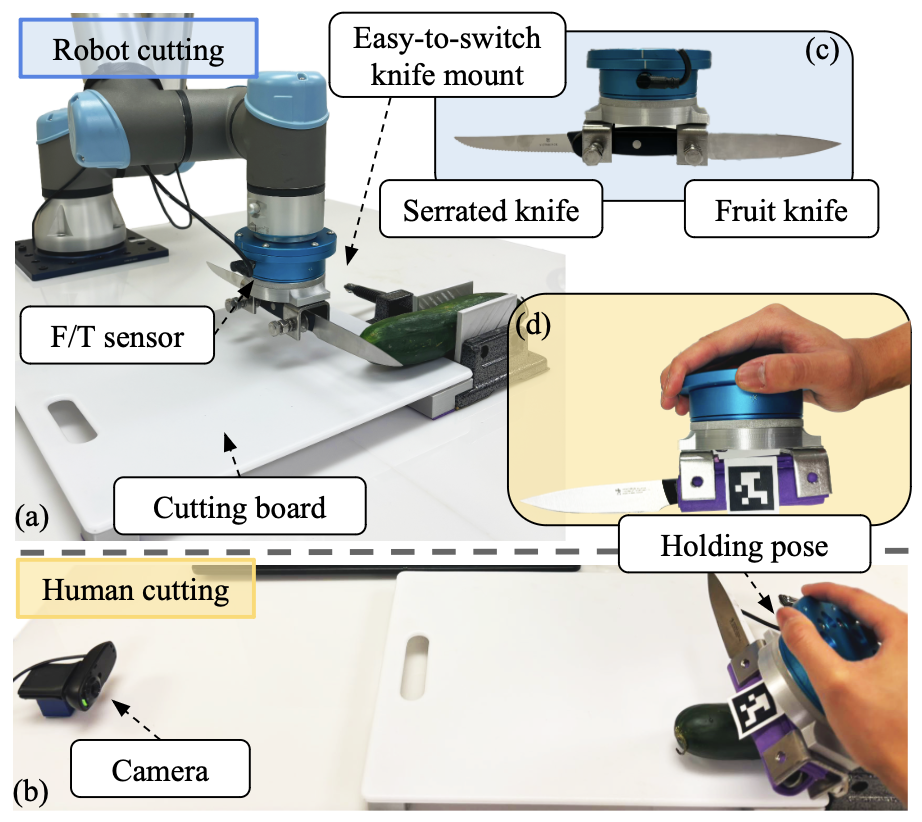
The platform uses a UR5e robot arm with a wrist-mounted force/torque sensor and an easy-switch knife mount that holds both a fruit knife and a serrated knife. A sliding vise secures the food during cutting. A separate human evaluation setup records force and motion from human cutting trials for comparison.
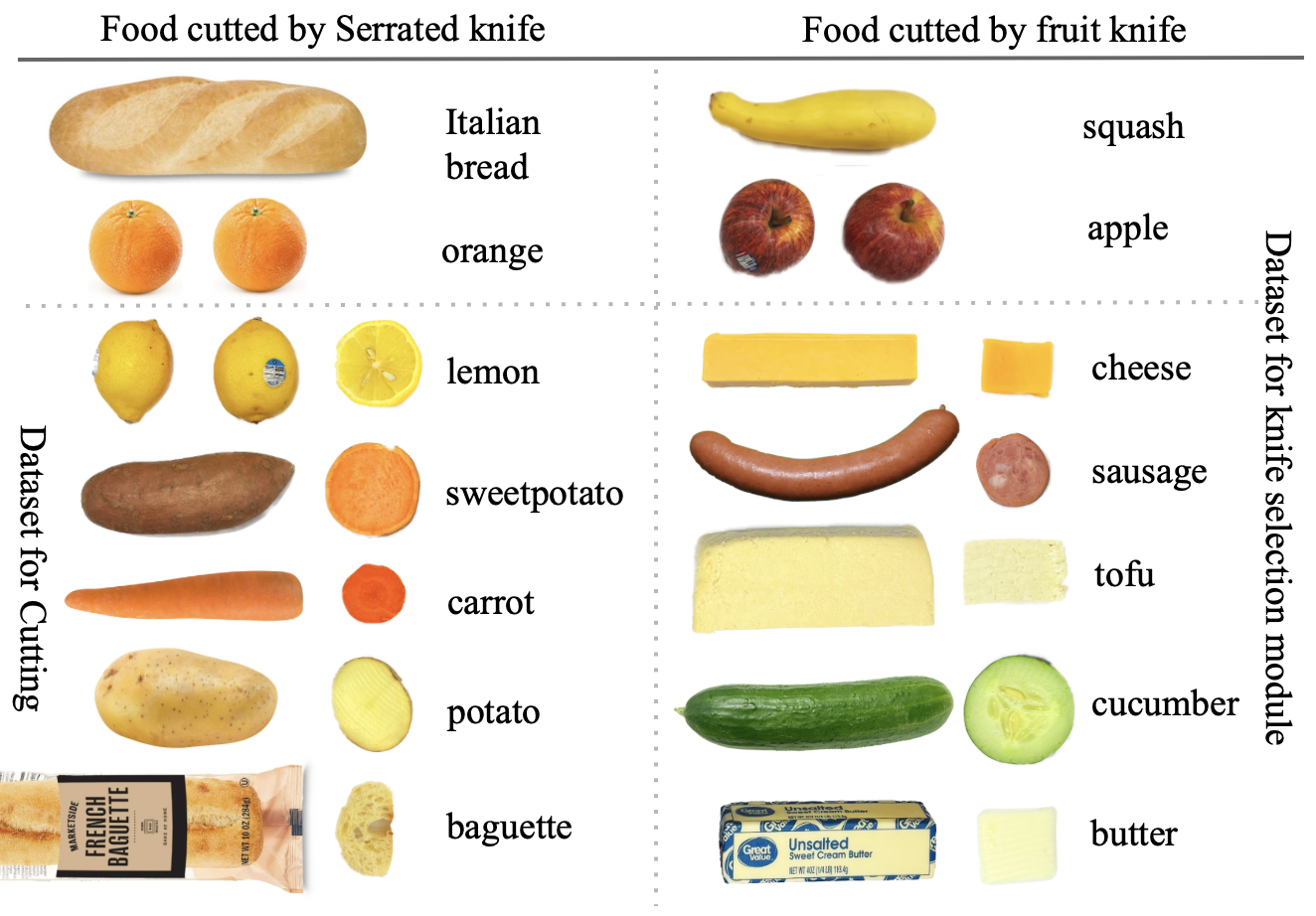
The experiments cover foods with a wide range of physical properties, from soft items such as tofu to hard items such as sweet potato. The dataset supports both knife-selection classification and cutting-policy evaluation across foods assigned to fruit-knife and serrated-knife categories.
The low-level controller tracks two interpretable parameters: target downward force and sawing speed. The reinforcement learning controller observes force and velocity feedback and updates these parameters online. The reward encourages downward cutting progress while penalizing mechanical work, allowing the policy to refine chopping and sawing behaviors from real robot interaction.
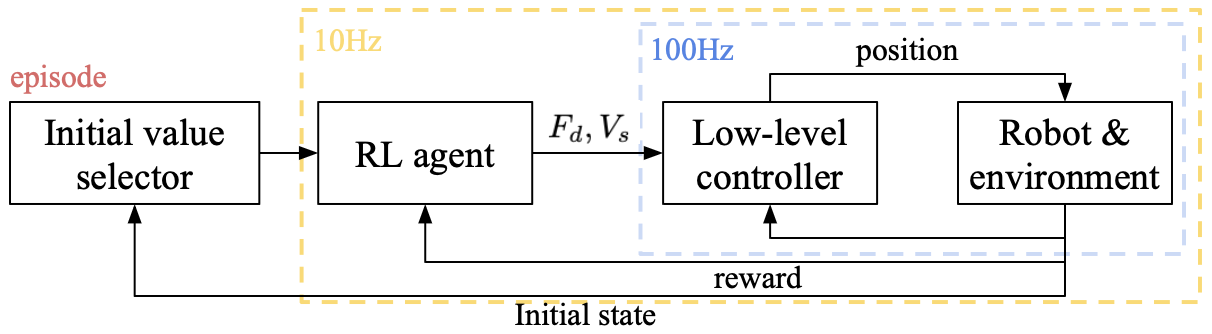
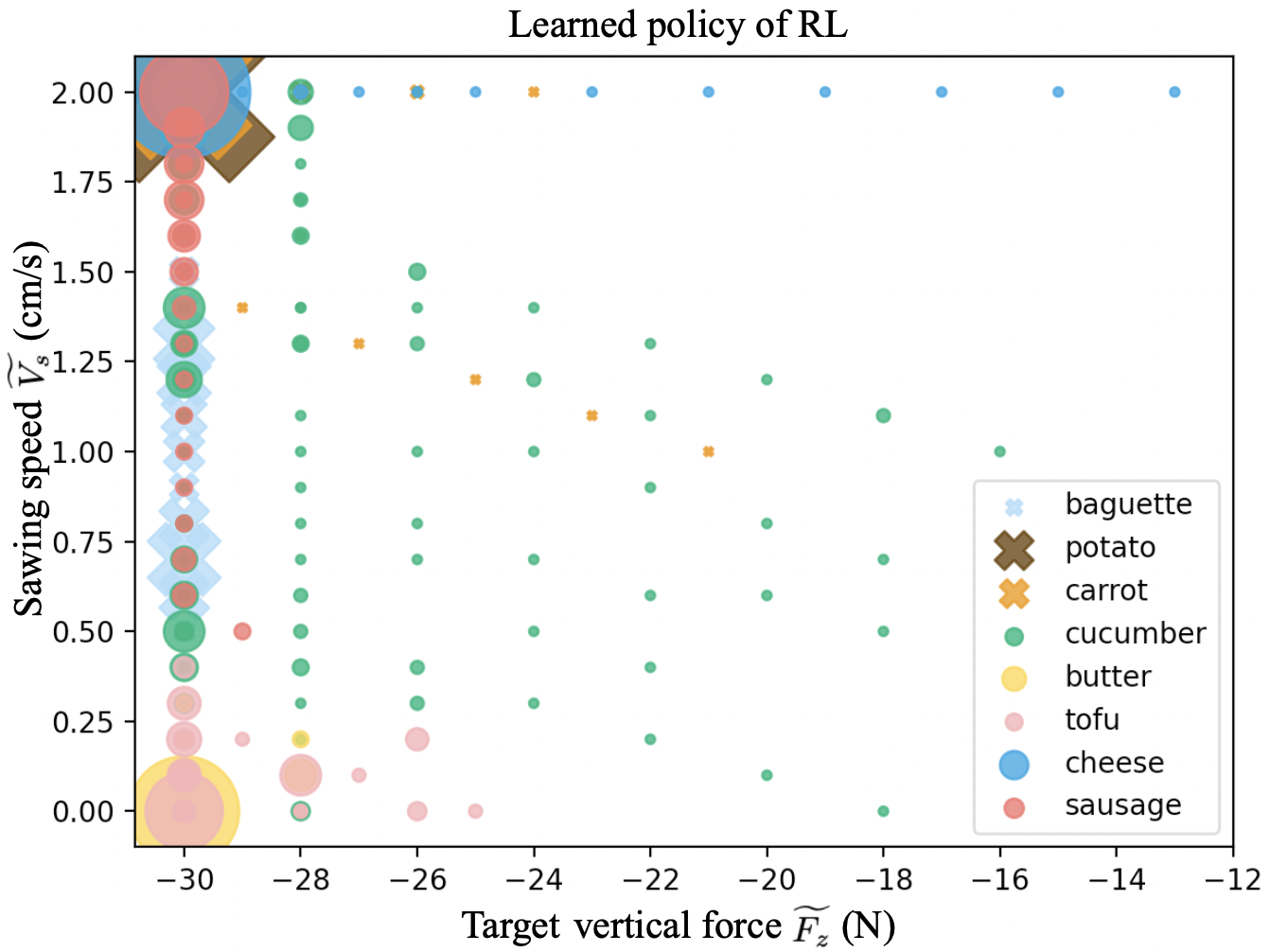
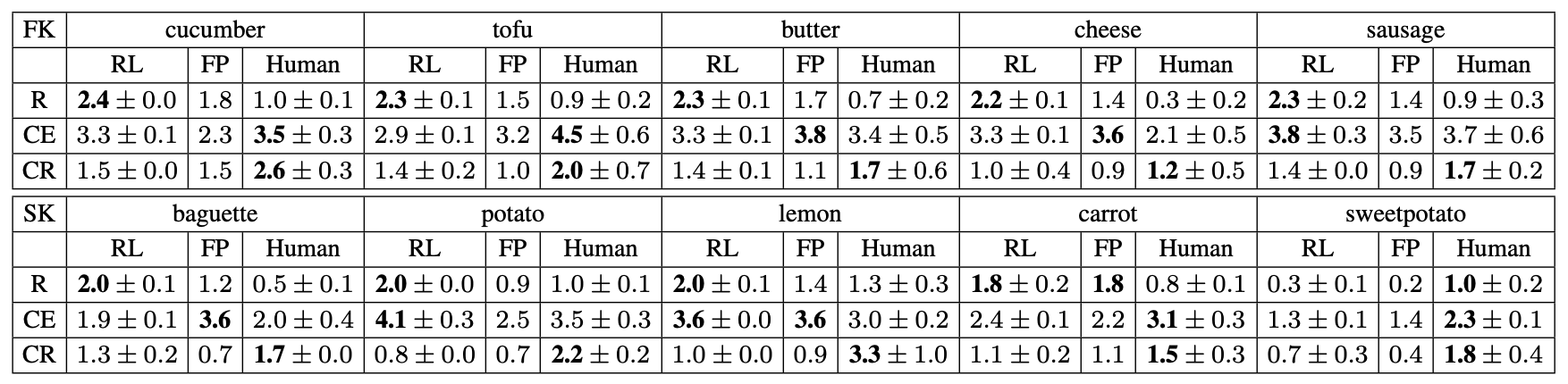
The trial-cut classifier selected the correct knife for unseen foods with 100% success in validation. In cutting experiments, the RL controller achieved the highest reward across most foods and showed comparable cutting efficiency to fixed policies and human trials. The learned policies often converged to interpretable modes, primarily chopping with high downward force or sawing with high speed.
The table summarizes the quantitative cutting evaluation across ten foods. We compare the reinforcement learning controller (RL), a manually chosen fixed policy (FP), and human cutting using three metrics: reward (R), cutting efficiency (CE), and cutting rate (CR). Higher values are better for all three metrics. Foods in the FK block are cut with the fruit knife, while foods in the SK block are cut with the serrated knife.
@inproceedings{luo2026robocutting,
  author = {Luo, Xinyuan and Yuan, Wenzhen},
  title = {A Perception-Manipulation Robotics System for Food Cutting},
  booktitle = {2026 IEEE/RSJ International Conference on Intelligent Robots and Systems (IROS)},
  year = {2026}
}